
Insights / AI & Operations
How to Choose Your First AI Workflow

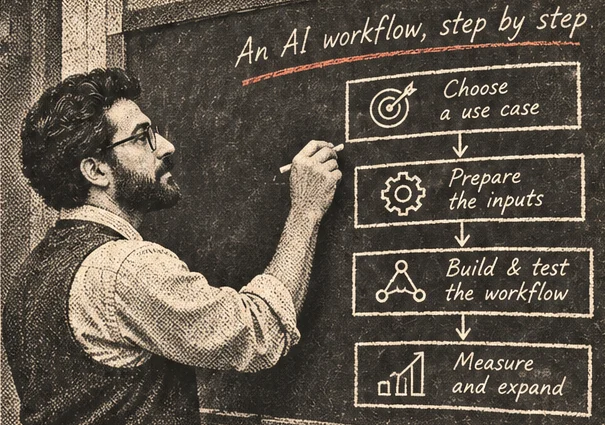
An AI pilot should begin with a task someone already needs to finish. A purchasing team matching supplier confirmations to purchase orders is a better starting point than a request to “bring AI into procurement.” The first has inputs, exceptions, an owner, and a measurable outcome. The second is still a slogan.
Choose a Workflow You Can Observe
Write down what triggers the work, who handles it, which systems they consult, and what they produce. Follow several real cases from beginning to end. Include an awkward case: a missing attachment, contradictory dates, or an unfamiliar supplier. These cases often reveal where the work actually happens.
For each candidate, record weekly volume, time per case, error consequences, data availability, and the effort required to review an answer. A high-volume task is not automatically a good candidate. If checking the generated answer takes longer than doing the work, automation has moved the effort rather than removed it.
Separate Rules From Interpretation
Use ordinary software for exact arithmetic, permission checks, required fields, and matching stable identifiers. Consider a language model where the input needs interpretation: extracting a delivery commitment from an email, summarizing a maintenance note, or classifying an ambiguous request.
Imagine a supplier email that says “the remainder should leave next Thursday.” A model may help interpret the phrase, but it cannot establish which order the supplier intended if the evidence is missing. The workflow needs an unresolved state and a person who can ask the question.
Build a Small Evaluation Set Before the Interface
Collect representative examples that you are permitted to use. Remove unnecessary personal and confidential information. Have the process owner record the expected result and explain what counts as an unacceptable error. Keep some examples separate from the cases used while developing prompts.
- Can the system identify the correct order?
- Does it preserve quantities, units, and dates?
- Does it show the source supporting its answer?
- Does it ask for review when the source is incomplete?
- Can a reviewer correct the result without restarting the task?
Evaluate the complete workflow, including retrieval and system integration. A model that answers a clean test prompt well can still fail when a document is outdated or a user lacks access to the relevant record. Treat instructions inside incoming documents as data, not authority to perform actions.
Measure the Economics of Review
Suppose, as an illustrative calculation, a team handles 500 cases each month at eight minutes per case. That is about 67 hours. If assistance reduces average handling time to three minutes, the gross saving is about 42 hours. Subtract exception handling, quality checks, software costs, and maintenance before calling that a business benefit.
Time saved also needs somewhere to go. Agree whether the team will clear a backlog, improve response time, or absorb additional volume. Avoid claiming cash savings unless spending actually falls.
Roll Out With an Owner and a Stop Condition
Start in shadow mode: generate suggestions without changing business records. Compare them with normal work. Then allow a small group to approve suggestions, with logs and a straightforward manual fallback. Define which errors pause the pilot and who can make that decision.
A useful first release may only draft a response or prepare a record for approval. Autonomous purchasing, payment, or production changes need a different level of control. Expand permissions only when evidence supports the change.
What Should You Have After the Pilot?
You should have a measured baseline, a reviewed test set, a named owner, an exception path, and a decision to expand, revise, or stop. A polished demo alone does not answer whether the workflow is worth operating.
If your underlying records are inconsistent, begin with the data and process work described in this production planning guide. If the pilot needs deep ERP changes, use the ERP decision framework before committing to a new platform.