
Insights / Production Planning
Production Planning: Fix the Constraints Before the Schedule


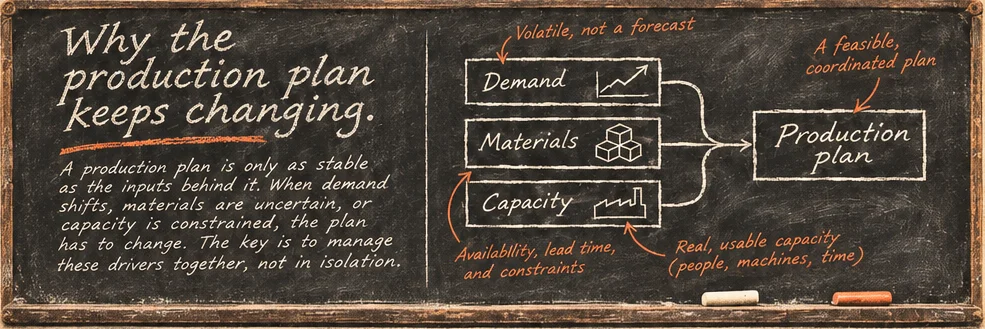
When a production schedule changes every morning, buying a new scheduling tool is an understandable response. But a schedule can only be as reliable as the assumptions behind it. Missing components, optimistic run times, and unrecorded changeovers will destabilize an expensive system just as effectively as a spreadsheet.
Follow One Late Order Backward
Choose a recently delayed order and reconstruct its path. When was the date promised? When did material become available? When was the order released? Which operation waited longest, and why? Compare recorded times with what the planner and operators remember.
The aim is to locate the first point where the plan became impossible. If the customer date was accepted before capacity was checked, improving dispatch rules on the shop floor will not resolve the original problem.
Calculate Available Capacity Honestly
Nominal shift hours are not productive hours. Account for planned maintenance, staffing, setup, breaks where relevant, and the mix of work. Use consistent definitions so that losses are not deducted twice.
Consider an illustrative work centre with 420 available minutes after planned exclusions. If the day requires 60 minutes of setup and each unit needs six minutes, the theoretical capacity for that mix is 60 units. It is not 70. Unplanned losses and quality issues can reduce the result further; the calculation is a starting assumption to validate, not a delivery guarantee.
Look at the Constraint, Not Just Average Utilization
A factory can have spare capacity overall and still miss deliveries because one process limits the relevant product family. Inspect queues before constrained equipment, specialist labour, inspection, and outsourced operations. The bottleneck may move as the product mix changes.
Keeping every resource busy can increase work in progress without improving completed output. Before releasing another batch, check whether the downstream operation can absorb it and whether the required materials are actually ready.
Make Material Readiness a Release Condition
Inventory on a report is not always usable inventory. Stock may be reserved, awaiting inspection, in the wrong location, or recorded in an inconsistent unit. A practical release check confirms the full kit, current drawings, tooling, and any required approvals.
- Who owns shortages before the order reaches production?
- Which supplier dates are confirmed rather than estimated?
- Can substitutions be approved without informal messages?
- Does the planner see quality holds and reservations?
A readiness flag is useful only if someone maintains it. Assign responsibility and record when the status was last checked.
Agree on Rules for Changing the Plan
Not every urgent request deserves to interrupt the current sequence. Define a short planning horizon within which changes require explicit approval. The right length depends on your lead times and operating conditions; there is no universal number.
When a change is approved, show the displaced orders and the resulting delivery risk. This turns expediting into a visible business decision instead of an invisible cost borne by production.
Run a Focused Daily Review
Review the constrained operation, orders at risk, material shortages, and yesterday’s largest deviations. Give each exception an owner and next action. Keep general reporting out of this meeting unless it changes a decision today.
Track schedule attainment with a stable definition, on-time delivery, work in progress, and the age of blocked orders. Avoid improving one metric by quietly changing its denominator or pushing unfinished work into another department.
Then Decide What Software Must Do
Once the operating rules are clear, define the software requirements: finite capacity where needed, material visibility, reliable routing data, exception ownership, and a history of planning changes. Test a real difficult order in any proposed system.
Read the ERP decision framework before replacing the core platform. For interpreting notes or supplier messages, an AI-assisted workflow may help, but it cannot manufacture missing capacity or make inaccurate records true.
 Read the production planning guide →